Leaderboard




Popular Content
Showing content with the highest reputation on 07/13/2018 in all areas
-
You wanted them, WE GOT THEM! PICTURES! Alright first I worked on the strapping system for the codpiece and the butt plate. Essentially I've got some 1 inch Nylon webbing and marine snaps that hold things together. The magnets don't do anything, they just are solidly glued. I have open snap spots just in case I decide at some point I need more straps. I did the same snap method for the butt plate and cod piece. The TD is only held on right now with the plastic hook I created on top. Then I was in a rut waiting on my harness system to get sewed. So I worked on the helmet: Wet sanded with 600 grit on the primer and taped up. Wrapping up the work on the helmet while waiting. After the harness is done I can finalize snaps and then get working on the rest.3 points
-
3 points
-
I say it just be eliminated from level 3 that you can’t have return edge. Then leave it as purely optional at the least.2 points
-
If you bought the TD clips from me then the screws are correct, if you got the screws from Joseph then the screws are correct. I can't vouch for anyone else2 points
-
Hey guys, Andrew – can you please update the first post so that there is a list of changes and their status as the first part? It will keep things clean for tracking. Any changes should be in keeping with the spirit of the awards, e.g. EI = a step up from base CRL that can be done for a low to moderate cost, and a moderate amount of effort. Parts/changes should be easy to come by. Centurion = as good as we can get it and builds upon L1/L2 requirements. Thus we’d never want to put something in EI that is very hard to do, or requires an extensive mod or a part that is very hard to get or expensive. Also, realize that we can’t include every possible permutation or costume flubs, e.g. just because there is a single TK on screen that does not have a holster doesn’t mean we’ll allow them to be optional, and just as there is – on BluRay freeze frame – gaffers tape and paint boo-boos doesn’t mean we’ll allow them either. CRLs should be pretty static and are usually done once a year for major changes. The ones we are doing monthly are usually small adds to L2/L3 that shouldn’t really affect people who’s builds are in flight. L1 items again if monthly are usually small items. The “official stance” is really whatever the DL & LMO agree on. Ultimately, the CRLs are owned by the LMO team and as they have trust in DLs, they allow the DL’s to make changes directly. Since I’ve been involved with the CRL process for over a decade and have written or re-written dozens of CRLs across 3 detachments, they’ve been pretty good about letting me update them directly. At some point it would be great to have a trusted FISD staff member as back-up, as at some point I’ll want to pull an Albin and retire from day-to-day. For ROTJ for the rivets on the shoulders, this is why it is a case where we start with making it optional for those who want to do it, and would only make it mandatory if for instance we only find one person without them. As noted, we do move quickly on FISD mainly as we have a very mature and seasoned team in place. I was reading chatter over at one detachment where most staff were pretty new and had little idea as to the CRL process, and as a result they spent a lot of time churning on this. For the CRL models, we change them as we get better models is really all there is to it. As for text vs. pictures, I’ve been a GML for 10+ years and can certainly say that neither on their own is adequate. The reality is that neither can really stand on their own, and if GMLs are confused to me this is a failure of training new GMLs. Sad that some garrison's just aren't that squared away.2 points
-
FYI, the Legacy Era Female now has a DLT-19 as an accessory.2 points
-
Land o' legs -- Part I I've set the arm assemblies aside for now till I can get some experienced eyeballs on them to take a look at my sizing. I think I have both the forearms and biceps just about right, but I definitely want some second opinions before I start slathering glue and cover strips on those. I'm eager to finish those assemblies, but there's plenty more to do with this build so I'm moving on to the legs for now. With A.M. armor, making the cuts on half of the legs is waymo easier than other armor not as generously sized. There's lots of extra plastic here, and a quick overlap and test shows that I won't need shims at all on the backs no matter how I cut the fronts. With that in mind I can, without fear, go ahead and cut the fronts to 10mm on each side as the base for the front 20mm cover strips before doing the actual sizing of the entire part. Unless you're a big trooper and need all that extra plastic, trimming the fronts of A.M. legs is important for the fitting process: As with the arms in the earlier section, there's just too much plastic to overlap during the sizing process to get an accurate fitting. Starting with the shins, I removed all of the lower return edge. Don't need any down there over my boots. I found that I couldn't clamp the part to my assembly table as I did the forearms because of the shin's ridged top and overall shape. Instead, I clamped a flexible metal straightedge directly to the shin itself to make my scoring cuts. By the way, you'll probably use spring clamps for something like this, but since I have a woodworking shop I have boatloads of these small bar clamps and prefer them for any flat surface due to their unmatched strength -- clamp up a straightedge with these and it just isn't going to move. If you use bar clamps for any part of your build, mind the free ends or you'll put your eye out, kid. The process of making all four cuts, two per leg remember because I'm only doing the fronts here, went smoothly. I'm still taking my time and being careful, but I'm not nearly as terrified as I was making those first cuts on the arms and biceps. As with the arms/biceps, I lightly sanded the cut edge to remove high spots and rough edges. Let's tape up the shins and see how they look. Yeah, that's the ticket. Nice and flush all down the line. There's still a lot of extra plastic on the backs, but I'll get that once I've marked the backs for fitting. Here's the thing, though: I can't do that by myself. I have no idea how you folks who did these without help managed it -- without being able to see the entire back of my shins as I fit them, I simply can't trust my guesswork at getting them marked accurately. Unfortunately, Mrs. Stormtrooper is out of town so her assistance isn't available. I thought about calling the retired lady next door to ask for a bit of help, but stopped when I imagined the conversation. ME: "Hi, Marion... Hey, have you got a few minutes to help me out with something?" NEIGHBOR: "Sure A.J. What do you need?" ME: "Well, I need you to come over and hold my legs for me while I get out a bunch of tape. Give me a couple minutes, though, because I have to put on some tight black leggings first." NEIGHBOR: *click* Yeah, that won't work. I'll wait till Mrs. Stormtrooper comes home or till I can get a Garrison member to help out. OK, I'll move on to the thighs. (Ha! Imagine replacing "legs" with "thighs" in that hypothetical phone call above.) As with the shins, there's far more plastic on these than I'll need, so I can safely cut those fronts to the required 10mm per side and still have plenty of overlap in back for fitting purposes. First, though, I want to trim the return edges. After all the reading I've done here, I've decided I don't want any return edges at the thigh tops for comfort and mobility. Plus, the A.M. legs are large and I'm sure I'll need to trim a bit off the tops anyway, so before fitting they have to go. There's a good bit there so I first used my Lexan scissors to cut most of it off. Then I went over to my drill press -- still fitted with that Microplane rotary shaper you saw in the arms section -- and ground it off the rest of the way. I also removed some of the return edge on the lower raised ridge. I didn't take all of that off, however, and instead trimmed it so it was at the same level as the inner sides of thighs, which I confirmed by laying a straightedge across the bottoms. My main purpose for doing this at this stage is so I didn't have extra material pressing into my legs during the fitting process and adversely altering initial fitting. Secondarily, the inner surface of the plastic will ride and bump on my legs a lot while moving, and I didn't want large returns on the raised ridge digging into my knees. When the legs are complete and I can put the armor on, I may elect to take a bit more of that return off the lower ridges, but for now making those edges flush with the inner surface of the thighs should be enough. With the return edges trimmed and sanded smooth, I cut the fronts to the 10mm-per-side measurement and taped them up. Both came out just fine. Again, though, I have to stop until I get some help with the backs as far as fitting and marking. With that in mind, this will be the last of the leg stuff for a while. Still loads of other things to do -- trim and fit my chest, ab, back, kidney, butt... "Hi, Marion, this is A.J. next door. Yeah, if you have a couple minutes could come over and help me trim and fit my butt?" Uh, no. I think I can handle these without help. A.J.2 points
-
Hello all! I've seen a lot of confusion about wetsanding and polishing with the goal of increasing the shine. Lots of people mixing up terms and using the wrong methods/products at the wrong time/place. So I decided to put up a little tutorial to clear (hehe) things up. DISCLAIMER: I am not a professional, I do auto detailing in my spare time and have some experience with paint correction. This will be a pretty long tutorial but stick with me and hopefully we'll learn something 1. What is shine? To be brief: when something is really really flat, it will reflect a lot of light directly into your eyes, making it appear shiny. Below is an illustration of perfect paint reflecting light, this would look like glass: (Illustrations are not to scale, just there to give you an idea). But that's a show-car-130-hours-polishing-lunatic-finish. Most of us use spray cans, and spray cans suck. They spit out paint unevenly and most of it is propellant anyway. And we do it in conditions that are not optimal, so we end up with very uneven paint full of orange peel. For this tutorial i've prepared a plate of ABS plastic which has been painted black (easier to demonstrate) and clear coated. See this pic below? See that wrinkly, orange'y look to it? That's orange peel. Image 1: If we want to go the extra mile to get rid of this, we need to do.. 2. Sanding - Levelling the paint Using sandpaper is ABRASIVE. From Merriam-Webster: abrasive 1: causing damage, wear, or removal of surface material by grinding or rubbing Focus here being "removal of surface material". Every time you swipe that sandpaper it removes some material. What we are trying to achieve here is a flat surface, we are trying to flatten out those "peaks and valleys" by removing/flattening the clear coat. A sandpaper's "grit" determines if it's coarse or fine. A higher number means it's more fine, and will remove less material. A lower number means it's more coarse and will remove more material. You need to have enough clear coat on your piece to be able to do this correction. Or else you might sand into the basecoat or even the primer. Which sucks because that means a re-paint.. Here is a list of my PERSONAL sandpaper grits: 40 - Super coarse for doing an Alderaan on whatever you are working on, I never use this 80 - Very coarse, for removing material quickly. I use this on woodworking projects 120 - Quick removal of material while still being in control 180 - I use this to knock down 3D-print lines and filler 240 - Smoothing filler if i'm feeling a bit scared 320 - This is what I sand my parts with before primer 600 - For wetsanding my primer 800-1000 - Anything from color-coat/clear-coat fixes to wetsanding hard clear coat 1200 - For knocking down tough orange peel 1500 - For knocking down orange peel 2000 - For removing 1500 scratches 3000 - For removing 2000 scratches For this test piece I started with 1500 grit to knock down the orange peel as the clear coat I used is kind of soft. Keep in mind every sanding step in this tutorial is done wet/wetsanding. As you can see here i've flattened out the peel on most of the piece but I missed a spot. I went over it again and made sure the entire surface was equally "dull". After this I went over it with 2000 grit. This is a finer sandpaper and my goal here is to eliminate the scratches from the 1500 job. Notice the sanding marks going the opposite direction this time. This is a good way to gauge if you've successfully sanded away the marks from the previous steps. And finally I went over it with 3000 grit in the opposite direction to remove the 2000 grit marks. At this point you should start seeing some shine My camera really struggled to focus taking these pictures. And we're done with sanding! Dry off your parts and move on to.. 3. Polishing - Levelling the paint again, just very very little From Merriam-Webster: polished; polishing; polishes transitive verb 1 : to make smooth and glossy usually by friction : burnish 2 : to smooth, soften, or refine in manners or condition 3 : to bring to a highly developed, finished, or refined state : perfect This is were it gets confusing. Some people "put polish" on their car, but they really mean wax. Some people "polish in the wax". I mean, it's been used so much in so many different ways I know it seems confusing. For simplicitys sake: Polishing is the last step in paint correction. In the auto detailing world, if you would let's say fix orange peel on a car, you'd go through all the steps above then.. 1. Use a RUBBING COMPOUND with a machine to knock down the 3000 grit scratches, paint should look like ANH Vader at this point 2. Use a POLISH with a machine to further level the paint from the faint marks the COMPOUND may have left, at this point the paint will be as clear as an ESB Vader 3 Apply a WAX/SEALANT/COATING on top of the newly corrected and flawless paint, to protect it (and also add a tiny bit more shine). Wax/sealant/coatings will fill in tiny tiny scratches making the paint appear more shiny, but the effect will diminish as the wax deteriorates. Rubbing compound and Polishes are ABRASIVE, they will REMOVE clear coat, just like sandpaper, only much much finer. Think of them like liquid 30000 grit and 80000 grit sandpaper After drying off my newly 3000 grit sanded piece, I found a foam polishing pad, and primed it with some rubbing compound. Priming is basically just "feeding" the working area of your pad with polish so there are no dry spots. All my compounding/polishing was done by hand. I then applied some more compound to the pad, a pea sized drop and went to town in small, circular motions. Follow the instructions on your product. After finishing I wiped off with a microfibre cloth aaaand... BAM! Shine!! The compound I used was Menzerna FG-400. It's a really good compound, it finishes super fine and you could just leave it as it is right there! You can also use Meguiars M105 for this step. Or any "rubbing compound", as long as it doesn't have fillers/wax in it which will trick you and lie to you. You can also just straight up use a polish, but you might have to work a bit longer to achieve the same effect. Now on to the polishing, for this I did the exact same thing with a finer foam pad and Menzerna SF-3500 (Meguiars equivalent M205). Honestly it didn't make much of a difference since the FG-400 finished out so nicely. If you're using other products you may have to do this step if you see "haze" from the compounding step. I tried my best getting an in focus picture but my camera got so confused because of the shine 4. Wax/Sealant/Coating - Protective Layer A wax is a protective layer, it is NOT abrasive. At this stage you can add wax if you want, it'll protect the paint a bit and also give it a tiny bit more shine. It's the prep-work and COMPOUNDING/POLISHING that really makes it shine. I didn't bother adding wax to my polished test piece as it was already as good as it gets. I did however tape off the piece before polishing, so I had one side which was 3000 grit sanded, and one side that was polished. I tried adding wax to the sanded side: After buffing it off with a microfibre and removing tape: And that's it Hope you learned something! Any questions feel free to post them here and i'll do my best to answer. After closely inspecting the piece I can see some orange peel left, but that's from when I put my color coat on, which is under the clear coat.. oh well.. Spray cans suck!!1 point
-
I gotta give props to all of the people that have built this weapon before me as it made it so much easier. So starting out, I used a G36 airsoft gun as the base, 3" pvc for the barrel, 1/2" pvc for the fuel dispenser, and a Monster energy drink can for the fuel canister. I modeled and 3d printed all of the detail pieces like the tip of the flamethrower, the box right behind the tip, and some small pieces that were added to the body of the gun. The overall length is shorter than other builds I have seen, mine comes in right at 36 inches.1 point
-
Same problem we're resolving with the pop rivets used on the shoulders, sniper knee and ammo packs. Until last year when decent photos were brought forth no one knew better. Now that we have applicants asking if they can use them at the higher levels do we beat them to the punch when it comes to the return edge? To be honest, looking at older photos or newer ones can it be said without a doubt none of the ROTJ armor has wrist side return edge? It's the only armor that is overlap, is it then possible that it's the only armor that has return edge? Inquiring minds want to know Heck I can go either way to be honest,1 point
-
Nicely done Jared!1 point
-
Here is a question wrt to return edge - before you put this in a CRL - the question is what problem are you trying to solve? Has this come up a lot? We can't put every detail in a CRL, so usually put ones where people have issues.1 point
-
1 point
-
lol I know you purchased them from me, my point was either from me or Joseph you would have been covered1 point
-
EIB already submitted and waiting on outcome!1 point
-
Looks great. Nice Job! should be an easy approval. My only future critique would be to change the TD screws to pan head instead of flat. Move Along!1 point
-
This is a nice idea in theory but could cause issues. We have so much more information now on our costumes then we ever have. I mean look at the ROTJ CRL and the potential changes there. The CRL photos should barely be updated unless new information about the costume arises. Remember they are the standard for approval and ideally there should be one set of high quality photos taken that really depict that costume and that is it. Then all costume applications should be compared to that one high quality standard. The FISD is already criticized for changing the CRLs too often by some. Even though the CRLs that have been changed have been done so with careful oversight based on facts. Adding unnecessary yearly changes would only add to that frustration and add fuel for the haters.1 point
-
The poppers I have are strong I have them in my two TI costumes as well. so over a year, with 38 troops in the two costumes have survived without a hitch. The only difference is that on my TN (First Order) I have them attached with instant glue instead of E6000, as well as that they are more hidden in padding of that armour. Generally when attaching them to the elastic band I add a piece of either webbing or some other firm fabric to make sure they do not come out of the elastic too easily. That is the one thing I have had with my side straps on my ANH TI. The snaps image is indeed what I was looking for!! Thanks! I have it already for the front and back, but hadn't found it for the arms yet1 point
-
Congrats on your EIB!1 point
-
Glen is correct, we do have control over our CRL's, as should all detachments. I also think we probably move faster than most when it comes to revision, if you consider last year and into this year there is always conversation sparking up on one of our many costumes and we believe in making all changes for the better. Once we are satisfied that the changes and the language is right, then Paul will do his part and get them instated. As a side note, GML's are now formally advised to use a combination of the wording and images within the CRL's, so some of these changes will potentially need new images also added to the CRL. Do we need to look at the EI and Centurion photo check lists to make sure they are up to date as well.1 point
-
congratulations trooper and welcome to EIB !! Godspeed !!!1 point
-
I just used a scrap piece of clear plastic that had the right thickness. Anything will do, just got to have different grades of sanding paper to get that polished finish in the end.1 point
-
I think that’s his name, I only ever use his forum name or Q.1 point
-
https://www.starwarscostumeprops.com/listing/281425412/hengstler-400-counter-replica-lens-for also check out this guys stuff. Top notch casting and parts. the counter window part can be bought as it plus other nice options. I want to buy a complete blaster from him someday, but all those parts add up.1 point
-
Here is a thread about printing numbers. gmrohodes13 might be able to help make a number file you can print. He is super helpful.1 point
-
You’ll find it’s extremely useful to get ideas to use or even inspire you to try something new. Fieldmarshal also makes some great replic counters too but not sure if you are interested to buy another one. Doopy counter is fine, just needs a lot of work to bring out the details you want to incorporate. Looking forward to seeing what you do with it.1 point
-
Have a look at the blaster reference again for some ideas on this. It was a lot of work but I Carved out the insides of my doopy counter, added some real counter parts from a dollar store counter and cut some clear plastic to fit and sanded/polished it to a curved shaped and finish. There are lots of 3d options now for the clear window part that I have seen around. The numbers can be as a printed sticker/insert as well. Someone on the forum was customizing these for members I think a while back. If I find it I will post it for you.1 point
-
Well done. Great info!1 point
-
Hey Jared, thank you for your patience and welcome to your EIB application. CRL and EIB Application Requirements: Looks like all the required submission photos have been posted. Your armor appears to display all necessary elements as set out in the level 2 CRL. Fantastic job your build, absolutely beautiful. Thank you for making the corrected fixes as suggested by your fellow troopers. That said, Joseph and I would like to welcome you to Expert Infantry. Congratulations. Other-Armor Fit/Assembly: In this section we review observations made by your fellow troopers and ourselves. Some observations may lead to suggestions to improve the overall look of your armor. If any suggestion affects any application it will be listed separately in the above or below sections. At this time the only suggestion we have to to watch your back to kidney plate gap. There should be very little gap here. Centurion Suggestions: In this section we prepare you the best we can for Centurion. If there are any areas of concern they will be discussed here. As mentioned above please reduce the back to kidney plate gap. Thank you for a nice clean build and application .1 point
-
Inserting June's link here and pinning. https://www.whitearmor.net/forum/topic/44985-june-2018-request-for-crl-updates-thread/1 point
-
That's awesome! It think Walt (WTF - Walt's Trooper Factory) makes kid sized armor. You can find him on Facebook.1 point
-
Nice job Jon! The only things that stood out for me was the black space (between the shoulder bells and chest at the front) and the sizing of the biceps and forearms. Like Dan mentioned, they look fairly loose (too much girth). I don't know if this will affect basic approval (depends on your GML), but it will hinder movement while you are trooping. That extra bit of paint on the frown (as per Dan) would not hurt either. As far as any dressing or alignment issues - yeah, you definitely want someone in the know to help with pictures. A few adjustments here and there before the pictures may solve a number of issues noted above (except for the belt - Nice catch, Jordan). My perfectionist wife helped me out during pictures - I pretty much owe my Centurion approval to her . Again, nice job on the armor.1 point
-
Small update. I've been very busy the past few nights, so only had time to do this. I will get the other rigging photos tonight as I finish the snaps and get going on sanding. I installed the welder's mask liner with some CA glue and then padded the top and the sides with this lovely green padding stuff. This way it fits perfectly as well as isn't bobblehead trooper. Soon, gentlemen, soon1 point
-
Hiya, Regarding the bicep to forearm, here’s some useful bits. Popper method Glued Most seem to follow either of these methods, with the straps on the inside of the of the elbow (if that makes sense). Out of interest, how big are the poppers you’re using? Do you know how strong they are? I think most builds use between 12mm and 15mm poppers. A bit like this: Hope that helps a little. :-)1 point
-
Looking good! Shouldn't have any trouble passing basic now!1 point
-
That happens a lot, James, so I wouldn't sweat it. As long as they have white paint on them (even if a bit has rubbed off) it's not a big deal.1 point
-
I gave it a hot water bath to help stop it from pointing straight to the floor. The strap will also help for sure!1 point
-
Ooh, good catch Daniel. That would probably level out the brow issue.1 point
-
Ok I did a little brow trimming this evening and here are the results. The difference is subtle but I think it makes it look a lot better. Any thought?! Sent from my iPhone using Tapatalk1 point
-
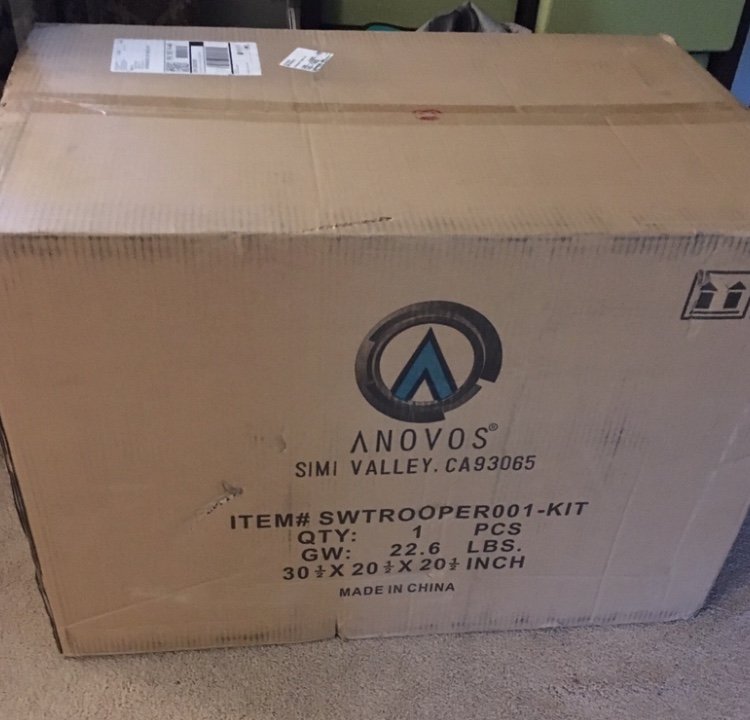
How I picture opening a box without a sharp object ------------ Sent from my iPhone using Tapatalk1 point
-
I've got a Hyperfirm for my EIB/Centurion submissions, and a Hasbro/Doopys conversion with electronics to troop with (because it goes pewpewpew with lights and the kids love it!). I've also got a Jawa Ion blaster with electronics (Lee Enfield conversion), and a T-21 in progress. Blasters are addictive!1 point